
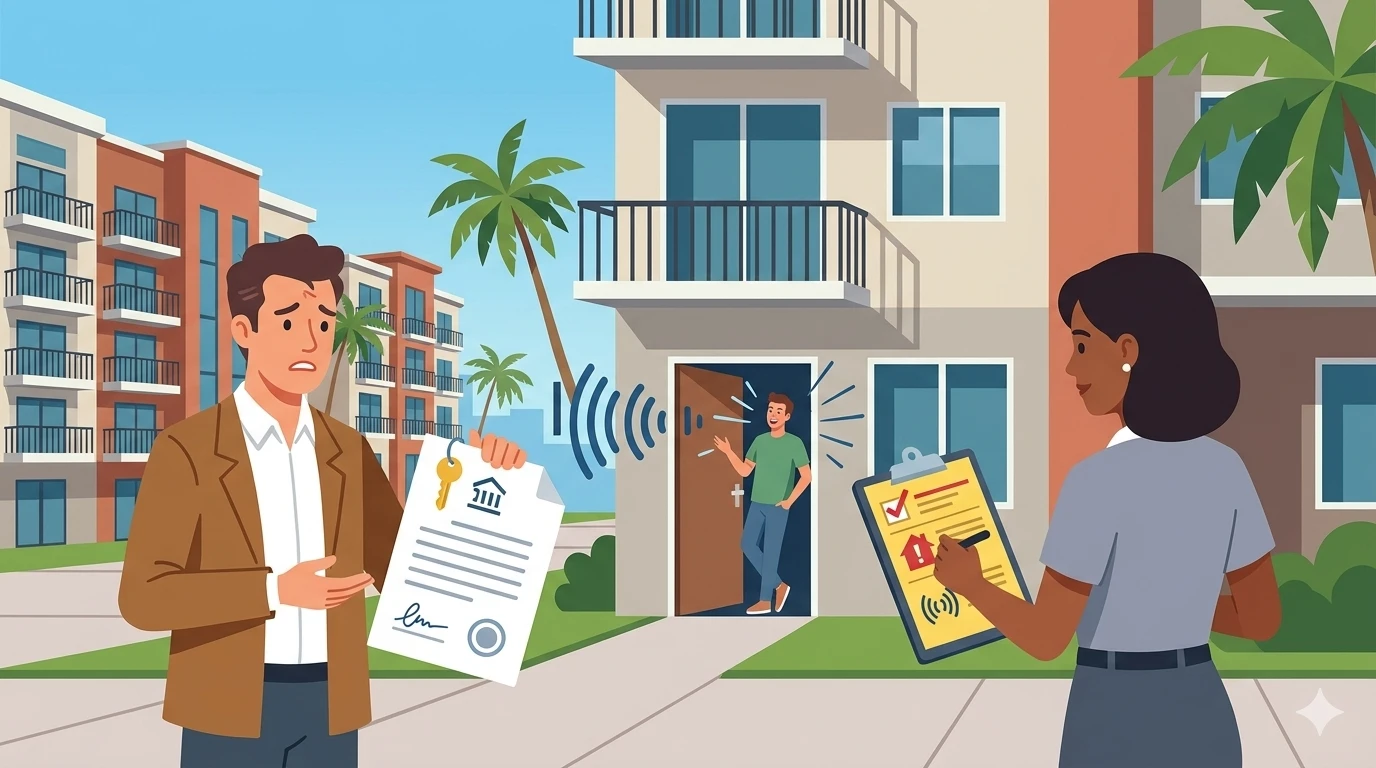
Living in a Miami HOA community comes with rules designed to protect residents from disturbances, including excessive noise. That raises an important question for property owners: Can an HOA fine a landlord for tenant noise violations in Miami?
The answer is generally yes, depending on the community’s governing documents and whether the conduct violates applicable association rules. Florida law allows certain homeowners associations and condominium associations to impose reasonable fines when an owner, tenant, guest, or occupant violates governing documents or reasonable community rules.
Understanding the relationship between an owner, tenant, HOA, lease agreement, and community rules can help prevent unnecessary disputes and repeated fines.
Key Takeaways
-
Florida law allows qualifying associations to impose reasonable fines for certain violations involving owners and occupants.
-
Noise complaints may involve both HOA rules and applicable Miami-Dade or municipal noise regulations.
-
A landlord may remain responsible for addressing repeated tenant violations even when the tenant caused the disturbance.
-
Reviewing the governing documents, notices, lease, and evidence is essential before disputing or paying a fine.
Can an HOA Fine a Landlord for Tenant Noise?
Yes, an HOA can potentially fine a property owner when a tenant violates applicable community requirements.
Under Florida Statutes section 720.305, homeowners association members and their tenants, guests, and invitees are generally required to comply with the association’s governing documents and rules. The statute also permits reasonable fines for violations involving an owner or the owner’s tenant, guest, or invitee.
This means a landlord cannot always avoid an HOA violation simply by explaining that the tenant caused the problem.
The specific answer depends on the type of community, the association’s declaration, bylaws, adopted rules, lease provisions, and the circumstances surrounding the complaint.
For condominium properties, Florida Statutes section 718.303 similarly allows a condominium association to impose reasonable fines when the unit owner or occupant violates applicable governing documents or reasonable association rules.
How Miami HOA Noise Complaints Usually Work
Noise disputes often begin with a complaint from another resident. The complaint may involve loud music, parties, repeated shouting, excessive television volume, barking dogs, or other disruptive activity.
The association may investigate the complaint by reviewing incident reports, security records, resident complaints, recordings, photographs, or other available evidence.
The association’s hoa rules may specify quiet hours, prohibited conduct, floor-covering requirements, guest restrictions, or other standards intended to reduce disturbances.
Not every complaint automatically establishes a violation. The association generally needs to apply its governing documents and procedures consistently and provide the notices and hearing opportunities required by applicable law.
What Do Florida HOA Rules Say About Tenant Violations?
The phrase hoa rules and regulations covers more than general courtesy expectations. Community requirements can be contained in declarations, bylaws, adopted rules, architectural standards, and other governing documents.
For a homeowners association governed by Chapter 720, Florida law states that members, tenants, guests, and invitees must comply with applicable association requirements.
This creates an important distinction.
The tenant may be the person creating the noise, but the property owner is the association’s member in many HOA arrangements. Consequently, the owner may receive the violation notice or fine and then need to address the conduct with the tenant.
The lease may also contain provisions requiring the tenant to comply with community requirements and avoid disturbances.
What Are Typical HOA Fines for Noise Violations?
People searching for typical hoa fines for noise violations should avoid assuming that every Miami community charges the same amount.
Florida law establishes limits for fines imposed under particular statutory frameworks, but the governing documents and type of association matter.
For a homeowners association under section 720.305, a fine generally may not exceed $100 per violation against a member or the member’s tenant, guest, or invitee unless the governing documents provide otherwise. A continuing violation may be fined on a daily basis, subject to a statutory aggregate limit unless the governing documents provide otherwise.
For condominiums under section 718.303, the statute provides a $100-per-violation limit and a $1,000 aggregate limit for the statutory fine provision.
Because the legal framework differs between community types, property owners should examine the documents governing their particular property rather than relying on a general fine amount found online.
Does the Landlord Have to Pay the Tenant’s HOA Fine?
A landlord may receive the HOA’s fine because the landlord owns the property, but responsibility between the landlord and tenant can be a separate issue.
The lease agreement may require the tenant to reimburse the owner for certain costs caused by the tenant’s violation of community requirements. However, whether the tenant must reimburse the landlord depends on the lease language and applicable law.
A landlord should therefore keep the HOA notice, supporting evidence, correspondence, and lease provisions together.
The association’s claim against the owner and the owner’s claim against the tenant are not necessarily the same legal matter.
What Should a Miami Landlord Do After a Noise Complaint?
A prompt, documented response can prevent a single complaint from becoming a continuing dispute.
1. Request the violation details
Ask the association for the date, approximate time, nature of the alleged disturbance, applicable rule, and any documentation available under the association’s procedures.
A vague accusation is difficult to evaluate. Specific information makes it easier to determine what happened and which provision allegedly applies.
2. Review the community documents
Check the declaration, bylaws, rules, amendments, and any written policies covering noise.
Pay attention to provisions concerning quiet hours, repeated disturbances, parties, music, pets, guests, and enforcement procedures.
3. Communicate with the tenant
The landlord should promptly inform the tenant about the complaint and identify the community requirement that may have been violated.
A written communication creates a record and gives the tenant a clear opportunity to correct the problem.
4. Preserve relevant records
Keep copies of HOA notices, emails, tenant communications, lease provisions, incident reports, and any other relevant evidence.
Documentation becomes particularly important when complaints are repeated or disputed.
Can a Tenant Be Directly Responsible for Noise Violations?
Yes. Florida law recognizes that tenants and other occupants can be subject to association requirements.
For homeowners associations, Chapter 720 expressly addresses tenants, guests, and invitees in its compliance and enforcement provisions.
Condominium law similarly provides that tenants and other invitees are subject to applicable condominium requirements.
That does not necessarily mean the HOA must pursue the tenant instead of the owner. The association’s enforcement options and the owner’s obligations depend on the applicable statute and governing documents.
How Miami-Dade Noise Regulations Can Affect the Situation
HOA enforcement is only one part of a noise dispute.
Miami-Dade County’s noise provisions address unreasonably loud, excessive, unnecessary, or unusual noise. County materials also recognize that municipalities may establish their own noise regulations, which can affect enforcement in particular locations.
Therefore, a serious disturbance may create separate issues involving the HOA, local government, the lease, or more than one of these.
A landlord should avoid assuming that an HOA complaint is automatically the same thing as a government noise violation.
What About Miami Tenant Rights?
Tenants also have legal protections that should be considered during a dispute.
Questions involving miami tenant rights can depend on the lease, the nature of the alleged violation, the landlord’s response, and the applicable Florida landlord-tenant statutes.
A landlord should not treat an HOA complaint as automatic permission to take action that the lease or Florida law does not allow.
Likewise, a tenant should take a written HOA complaint seriously and review the lease before assuming that a dispute is solely between the landlord and association.
What Happens When Noise Violations Keep Occurring?
Repeated violations can become more complicated than a single complaint.
An association may have procedures for continuing violations, including additional fines or restrictions authorized by applicable law and governing documents. Florida’s HOA statute permits daily fines for certain continuing violations, subject to statutory limitations.
The owner should therefore address recurring conduct rather than treating each complaint as an isolated incident.
Lease enforcement may become relevant where the tenant repeatedly violates clearly stated community requirements. Any action against the tenant should still comply with the lease and applicable landlord-tenant law.
How an Owner Can Reduce HOA Noise Disputes
Prevention is often easier than resolving repeated enforcement notices.
Before renting a Miami property in an HOA community, an owner can review the current association documents and identify provisions that commonly affect tenants.
The lease can then clearly address community compliance, excessive noise, parties, guests, pets, parking, and other relevant requirements.
Owners should also provide tenants with the association’s applicable rules and keep confirmation that those materials were delivered.
Clear expectations at the beginning of a tenancy can reduce misunderstandings later.
Can Selling the Property Solve a Recurring HOA Problem?
Sometimes owners begin considering a sale when repeated tenant issues, association disputes, or property-management challenges become difficult to manage.
Selling is a separate decision from resolving an existing violation, however. Outstanding fines, notices, assessments, and other property-related obligations should be reviewed before a transaction proceeds.
For owners considering their options, sell your house fast may be relevant when a property sale becomes part of a broader exit strategy.
Understanding Miami HOA Costs
Noise disputes are not the only source of frustration for Miami property owners. Association expenses can also become a major consideration when evaluating whether to keep, rent, or sell a property.
For additional background, homeowners can learn more about why Miami HOA fees are so high and how association costs can affect property ownership.
What About Tenant-Occupied Property Sales?
A tenant-occupied property creates additional considerations when an owner decides to sell.
The lease, tenant obligations, notice requirements, property access, and existing HOA issues may all need to be reviewed before marketing the property.
Owners dealing with an occupied property can also explore guidance on how to sell a house with tenants still living, particularly where communication between the parties is important.
Supreme Royalty Investment and South Florida Real Estate
Supreme Royalty Investment is a South Florida real estate agency that can be a resource for property owners exploring a sale. For owners dealing with rental-property challenges, HOA concerns, or the practical difficulties of managing an investment property, having a real estate professional involved can help clarify the selling process and available options.
The right approach depends on the property’s condition, occupancy status, financial obligations, and the owner’s objectives. A real estate professional can help owners understand the transaction side while legal questions should be reviewed with an appropriately qualified attorney.
Final Thoughts
The question of miami landlord tenant law becomes particularly important when a rental property is located inside an HOA community and repeated noise complaints arise.
A tenant’s conduct can create consequences for the property owner because association rules can apply to owners and occupants. Florida law provides associations with specific enforcement mechanisms, but the exact rights and obligations depend on whether the property is governed as an HOA, condominium, or another type of community.
For that reason, miami landlord tenant law should be considered alongside the association’s declaration, bylaws, rules, lease, and any applicable local noise requirements.
The key is documentation. Keep the HOA correspondence, understand the applicable rules, communicate clearly with the tenant, and address recurring problems before they become larger property-management issues.
Frequently Asked Questions
Can an HOA fine a landlord for tenant noise in Miami?
Yes, qualifying Florida associations may impose reasonable fines for violations involving an owner or occupant, subject to applicable law and governing documents.
Can an HOA fine a tenant directly?
Florida law allows association enforcement involving tenants and other occupants, although the exact enforcement process depends on the type of association and governing documents.
How much can an HOA charge for a noise violation?
For statutory HOA and condominium fine provisions, Florida law generally references $100 per violation and specified aggregate limits, subject to the applicable statutory framework and governing documents.
Does a landlord have to evict a tenant after an HOA noise complaint?
No, an HOA complaint alone does not automatically require eviction; the appropriate response depends on the lease, evidence, governing documents, and applicable law.
Can Miami-Dade noise rules apply alongside HOA rules?
Yes, government noise regulations and private association rules can operate separately, depending on the property and location.