
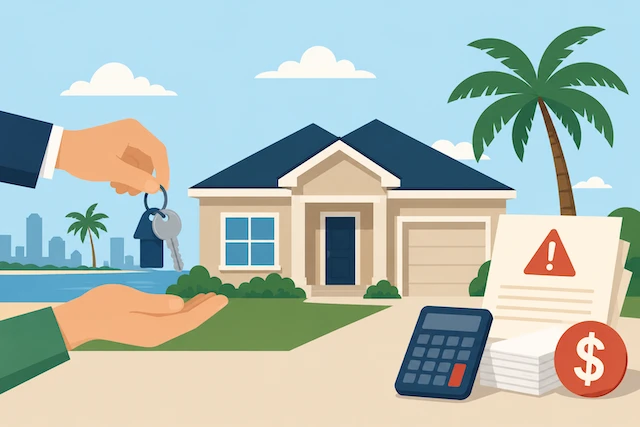
Selling a house with delinquent property taxes in Florida is possible, and in most cases the overdue balance is simply paid from your sale proceeds at closing. The real risk is waiting too long — Florida’s tax certificate and tax deed process can strip you of the property entirely if taxes remain unpaid for multiple years.
Key Takeaways
- Delinquent property taxes do not prevent a sale, but they must be paid off before or at closing — a title cannot transfer with a tax lien attached.
- Florida declares property taxes delinquent on April 1, after which the county holds a tax certificate sale — typically in May or June — beginning a clock that can ultimately lead to a tax deed sale and loss of the property.
- Interest and fees accumulate fast: under Florida Statutes § 197.172, delinquent property taxes accrue interest at up to 18% per year.
- Cash buyers, including companies like Supreme Royalty Investments, routinely purchase homes with property tax liens and handle the payoff as part of the transaction.
- Waiting for a traditional buyer through a realtor is riskier when taxes are delinquent — financing delays give the tax certificate process more time to advance.
- Homeowners facing tax delinquency should understand the difference between a tax certificate, a tax deed application, and a full tax deed sale, as each stage carries different consequences.
What Happens When You Stop Paying Property Taxes in Florida?
Florida’s property tax delinquency process is time-sensitive and structured by state statute. Missing even one year of payments starts a chain of events that most homeowners don’t fully understand until they’re deep into it.
Property taxes in Florida are payable beginning November 1 each year, with discounts available for early payment. If they remain unpaid on April 1 of the following year, the county tax collector declares them delinquent. Shortly after — typically in May or June — the county holds a tax certificate sale, a public auction where investors purchase the right to collect the debt, plus interest, from the property owner.
That tax certificate does not transfer ownership. But it does attach a legal claim to the property that must be cleared before any sale can close. Under Florida Statute § 197.502, if the certificate holder applies for a tax deed — generally no sooner than two years from April 1 of the year the certificate was issued — the county can schedule a public auction of the property itself, a tax deed sale. At that point, the original owner can lose the home entirely, often for far less than market value.
Under Florida Statute § 197.172, tax certificates carry a maximum interest rate of 18% per year. Section 197.432 governs the mechanics of the certificate sale itself, under which the winning bidder typically accepts a lower rate at auction.
Can You Sell a House With a Property Tax Lien in Florida?
Yes — a property tax lien does not legally prevent a sale, but it does control what happens at closing. The lien must be satisfied before a clean title passes to the buyer.
In practice, here is what that means:
- The title search conducted before closing will surface any outstanding tax certificates or delinquent tax balances.
- The closing agent (typically a title company or real estate attorney in Florida) will calculate the full payoff amount, including accrued interest and fees.
- The delinquent balance is deducted from the seller’s proceeds at closing.
- The lien is cleared, and the buyer receives a clean title.
This process works cleanly when there is enough equity in the home to cover the debt. If the outstanding taxes, interest, and other liens together exceed the sale price, you are looking at a short sale situation — which requires additional negotiation with lienholders.
For most homeowners, especially in South Florida where property values have generally remained elevated in recent years, the equity covers the tax debt comfortably — though sellers should verify current local market conditions before assuming a specific equity position. The problem is delay — every month the tax certificate accumulates interest, and every passing year brings a tax deed application closer.
How Much Do Delinquent Property Taxes Actually Cost You?
The dollar impact compounds faster than most homeowners expect. Here is a breakdown of what accumulates:
| Cost Component | Details |
|---|---|
| Base tax owed | Original unpaid annual tax bill |
| Interest | Up to 18% per year under Florida law (§ 197.172); certificate holders typically accept a lower rate at auction, though actual bid rates vary by county and market conditions |
| Advertising fees | County charges for public notice of delinquency |
| Tax certificate redemption fee | Required to clear the certificate before or at sale |
| Tax deed application fee | If a certificate holder files for a deed, additional costs attach |
| Title search and clearance costs | Paid at closing to confirm all liens are satisfied |
In practice, a homeowner who has fallen two or three years behind on taxes may owe the original annual bill multiplied by the years delinquent, plus accumulated interest on each certificate and various county fees. On a property with a $6,000 annual tax bill, three years of delinquency could produce a total payoff obligation exceeding $22,000 to $25,000 once interest and fees are factored in.
Those numbers do not destroy a sale on a home worth $350,000 or more — but they do eat into your net proceeds.
What Is the Timeline Before Florida Can Sell Your Home at a Tax Deed Sale?
Understanding the timeline gives sellers a clear picture of how much urgency is warranted.
- April 1 — Taxes declared delinquent for the prior year
- May or June — County holds tax certificate sale; investor purchases the certificate
- Two years after certificate issuance — Certificate holder becomes eligible to apply for a tax deed
- After tax deed application — County schedules a public auction of the property (typically 60–120 days later)
- Tax deed sale — Highest bidder at auction takes title; the original owner receives any surplus above the bid, but ownership is gone
The full process from first delinquency to tax deed sale takes a minimum of about two and a half years under normal circumstances. But that clock starts over with each additional unpaid year, and certificate holders do not always wait the full two years to apply.
Homeowners who are one year behind still have significant runway. Those who are three or four years behind need to act immediately.
How Does Selling to a Cash Buyer Help When Taxes Are Delinquent?
Selling to a direct cash buyer like Supreme Royalty Investments is one of the most practical exits available to a homeowner with delinquent property taxes. Here is why the model works better than a traditional listing in this situation.
No financing contingency. Traditional buyers depend on mortgage approval, which takes 30 to 60 days and can fall through. Every additional month gives the tax certificate process more time to advance. A cash buyer can close in as little as two weeks.
No inspection or repair demands. A home that has accumulated tax problems has often also deferred maintenance. Cash buyers purchase as-is, which removes the cost and delay of repairs that could stall a listing.
No appraisal delays. Mortgage lenders require appraisals. Cash sales do not. This removes another 10 to 21 days from the closing timeline.
Tax payoff is handled at closing. A reputable cash buyer works with the title company to identify the full tax payoff amount and ensures the lien is cleared at closing as part of the transaction. The seller does not need to find the funds upfront.
Certainty of close. When a tax deed application has been filed, certainty matters more than price. A cash offer that closes is worth more than a higher offer that spends six weeks in underwriting.
If you’re also dealing with a tenant-occupied property or liens beyond property taxes, the same logic applies — cash buyers are structured to absorb multiple complicating factors simultaneously.
What If the Tax Debt Exceeds Your Equity?
This is a harder situation, but it does not make a sale impossible. The options depend on how far underwater the property is.
If you are close to break-even: A direct cash buyer may still be able to make the numbers work, particularly if they can close fast and avoid agent commissions (which run 5–6% on traditional listings). Even a slightly below-market cash offer may net you more after commission, closing costs, and accumulated interest than a higher listed price that takes months to close.
If you owe significantly more than the home is worth: You may need to negotiate a short sale with both the mortgage lender and the county tax authority. This is a slower process but is preferable to a tax deed sale, which leaves you with nothing if surplus funds do not cover your mortgage balance.
If you have no mortgage: Selling short on the taxes alone is simpler — the only lienholders are the county and any certificate holders. A title company experienced with delinquent tax sales can structure the payoff.
Florida homeowners facing negative equity from multiple sources should also review the implications of selling a house with negative equity before choosing a path forward.
Steps to Sell a House With Delinquent Property Taxes in Florida
Follow this process to move from a delinquent tax situation to a closed sale with the least friction.
- Contact the county tax collector’s office. Get a full accounting of every certificate outstanding, the interest rate on each, and the total redemption amount. In Miami-Dade, Broward, and Palm Beach Counties, this information is available online through the county’s tax collector portal.
- Order a title search. A preliminary title search will surface every lien, not just tax certificates. This gives you and any buyer a complete picture of what must be cleared at closing.
- Calculate your net equity. Subtract the total tax payoff, any mortgage balance, estimated closing costs, and agent commissions (if using a realtor) from the home’s current market value. If the number is positive, you can close a sale. If it is negative, you need a short sale strategy.
- Request a cash offer. Contact a direct buyer like Supreme Royalty Investments for a no-obligation offer. The offer accounts for the property’s as-is condition — no repairs required before the evaluation.
- Review the offer against your net equity calculation. A cash offer without agent fees may net more than a listed price with commissions and carrying costs, especially when interest is accumulating monthly.
- Select a closing date. Cash buyers can typically close in 10 to 21 days. If the tax deed process is advancing, prioritize speed.
- Let the title company handle the payoff. At closing, the title company disburses funds to clear every lien — including all delinquent taxes and certificate holders — before transferring the deed.
Does Florida’s Homestead Exemption Protect You From a Tax Deed Sale?
Florida’s homestead protections are broad, but they do not prevent a tax deed sale on a primary residence. Property taxes are a constitutionally authorized exception to homestead protection under Article X of the Florida Constitution.
The Florida Homestead Exemption reduces the assessed value used to calculate your tax bill — which lowers the annual amount owed. But if that reduced bill still goes unpaid, the tax certificate and tax deed process proceeds regardless of homestead status.
This is a common misconception. Homestead protection shields your primary residence from most creditors and judgments, but it does not override the county’s right to collect property taxes.
Frequently Asked Questions
Can I sell my house if my property taxes are delinquent in Florida?
Yes. Delinquent property taxes do not block a sale — they are treated as a lien that must be paid off at closing. As long as your home has enough equity to cover the outstanding tax balance plus any other liens, the sale proceeds normally. The title company handles the payoff as part of closing.
How long does Florida give you before a tax deed sale?
The earliest a tax deed sale can occur is roughly two and a half years after the first missed tax payment — tax certificates are sold the April after delinquency, and certificate holders must wait two years before applying for a tax deed. After the application, an auction is typically scheduled within 60 to 120 days. Timelines vary by county and certificate holder.
Will a cash buyer purchase my home if I owe back property taxes?
Yes. Cash buyers, including Supreme Royalty Investments, routinely buy homes with delinquent property taxes. The unpaid balance is factored into the transaction and cleared at closing by the title company. You do not need to resolve the taxes before accepting an offer or agreeing to a sale.
What happens if I owe more in taxes and liens than my home is worth?
You will likely need to pursue a short sale, which involves negotiating with lienholders to accept less than the full amount owed. This is more complex than a standard sale but is still preferable to a tax deed sale, which removes your ownership with little to no financial recovery. A Florida real estate attorney can help structure a short sale in this scenario.
Does the Florida homestead exemption protect my home from a tax deed sale?
No. Florida’s homestead exemption reduces your annual tax bill by lowering assessed value, but it does not prevent a tax deed sale if those reduced taxes remain unpaid. Property taxes are constitutionally exempt from homestead protection in Florida.
How fast can I close a sale when taxes are delinquent and time is running out?
A direct cash sale is the fastest option available. Companies like Supreme Royalty Investments can close in as little as 10 to 14 days in straightforward cases. In urgent situations where a tax deed application has already been filed, communicate that timeline immediately — experienced cash buyers can often expedite the process further.
Delinquent property taxes in Florida create real urgency, but they rarely eliminate your options. The equity in your home is your most important asset — and in most cases, it is more than sufficient to cover the tax payoff at closing. The worst outcome is waiting until the tax deed sale removes that equity entirely.
If you are behind on property taxes and need to move fast, Supreme Royalty Investments will review your property as-is and present a straightforward cash offer with no obligation. Get your free offer today before the timeline gets shorter.