
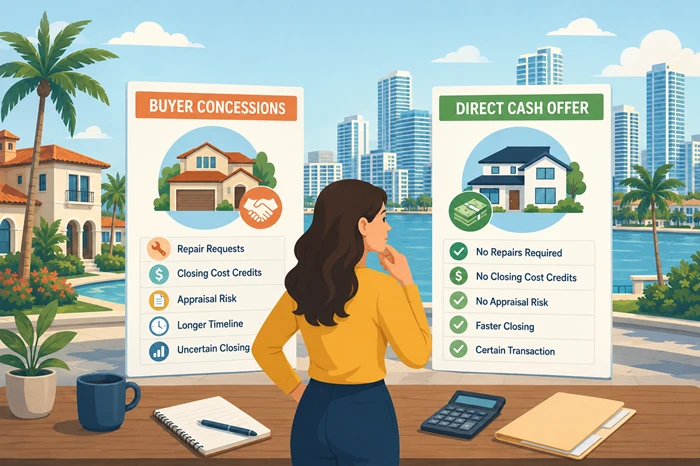
Selling a home in Miami can involve more negotiation than many homeowners expect. A buyer may present an attractive purchase price but later request repairs, closing-cost credits, inspection concessions, or other financial adjustments that reduce what you actually receive at closing.
That is why comparing buyer concessions with a straightforward cash offer is so important. The highest offer on paper is not always the strongest offer when delays, financing risks, repair requests, and closing expenses are considered.
Key Takeaway
-
Buyer concessions can reduce your final proceeds after negotiations begin
-
Cash transactions may offer greater certainty and fewer financing-related delays
-
The best option depends on your timeline, property condition, and net proceeds
-
Always compare the final amount you receive, not just the original offer price
Understanding Buyer-Concession Demands
A buyer concession is something the seller agrees to provide in order to help move the transaction forward. These requests can appear during negotiations, after the inspection, or when the buyer’s financing is being finalized.
Common concessions include closing-cost assistance, repair credits, price reductions, rate buydown contributions, or paying for specific property issues discovered during the inspection.
At first glance, accepting these requests may seem like a reasonable way to keep a sale alive. However, each concession can reduce your final proceeds and make the transaction more complicated.
Common Types of Buyer Concessions
A buyer may ask the seller to cover part of their closing costs. In another situation, an inspection may uncover issues that lead to requests for repairs or financial credits.
Some buyers may also renegotiate when an appraisal comes in below the agreed purchase price. If the buyer cannot cover the difference, the seller may be asked to lower the price or make additional concessions.
This means a seller should evaluate the entire transaction rather than focusing only on the initial offer amount.
Why the Highest Offer Is Not Always the Best Offer
A traditional offer can look impressive when the purchase price is higher than competing proposals. But the advertised number does not always represent the amount that eventually reaches the seller.
Consider a homeowner who receives a high financed offer with a request for closing-cost assistance. After the inspection, the buyer asks for repair credits. If the appraisal creates another issue, the seller may face additional pressure to renegotiate.
By the time the transaction closes, the seller’s actual proceeds may be significantly lower than expected.
This is where comparing net proceeds becomes essential.
Looking Beyond the Purchase Price
When evaluating an offer, consider questions such as:
-
How much will I actually receive after concessions?
-
Is the buyer relying on mortgage approval?
-
Could the inspection lead to additional negotiations?
-
How long is the expected closing timeline?
-
What happens if financing or appraisal issues arise?
A lower but cleaner offer may sometimes provide more certainty than a higher offer loaded with conditions.
For homeowners who need to move quickly, this calculation becomes even more important. If timing matters, exploring options that allow you to sell your house fast may help you avoid a prolonged traditional selling process.
How Net Direct Cash Offers Work
A cash offer means the buyer is purchasing the property without relying on a traditional mortgage for the transaction. This can remove one of the most common sources of uncertainty in a conventional home sale.
The key advantage is not simply that the buyer has cash. The value often comes from the potential for a simpler transaction with fewer lender-related requirements.
However, sellers should still carefully review the terms. Not every cash proposal is identical, and the purchase price alone should not determine which option is best.
Direct Offers Can Simplify the Comparison
When evaluating direct cash offers, homeowners can often focus on the actual terms of the transaction rather than trying to predict how much a financed buyer may request later.
A clear offer should help you understand:
-
The proposed purchase price
-
Expected closing costs
-
Whether repairs are required
-
The anticipated closing date
-
Any inspection or due-diligence conditions
-
The estimated amount you will receive at closing
The goal is to compare the complete financial picture.
Buyer Concessions vs. Cash Offers: The Real Comparison
The central question is not whether one option is always better. Instead, sellers should compare certainty, speed, convenience, and final proceeds.
Traditional Buyer With Concessions
A financed buyer may offer a higher purchase price, but the transaction could involve inspections, appraisals, lender requirements, and additional negotiations.
If everything goes smoothly, the seller may achieve a strong result. But there is also a greater possibility that the original terms will change before closing.
This option may work well for sellers with time to wait and a property that is likely to perform well during inspections and appraisals.
Cash Buyer With Cleaner Terms
A cash transaction may offer a simpler path to closing, particularly when the property needs repairs or the seller wants to avoid extensive negotiations.
For some homeowners, certainty and convenience have real financial value. Avoiding months of carrying costs, repeated showings, repair work, or a failed contract can make a straightforward transaction more attractive.
When comparing cash home buyers Miami, it is important to review the complete offer and understand exactly what obligations remain before closing.
How Concessions Can Affect Your Final Proceeds
A seller may agree to a concession because they believe it is a small compromise. But several concessions can add up quickly.
For example, a seller could agree to:
-
A closing-cost credit
-
Repairs following an inspection
-
A price reduction after appraisal
-
Additional credits requested before closing
Each adjustment reduces the seller’s financial outcome.
That does not mean concessions are always bad. Sometimes accepting a reasonable request is the best way to complete a profitable sale. The important point is to calculate the final numbers before making a decision.
A helpful way to evaluate offers is to create a simple net sheet showing the purchase price, expected expenses, concessions, repairs, and estimated proceeds.
Miami’s Real Estate Market Adds Another Layer
The diversity of miami real estate means sellers can face very different situations depending on location, property type, condition, and buyer demand.
A renovated property in a highly competitive neighborhood may attract multiple buyers and give the seller more negotiating leverage. A property needing substantial work may attract buyers who expect repairs or price adjustments.
Market conditions can also influence how aggressively buyers negotiate.
That is why there is no universal rule that says a traditional offer or cash offer is automatically the better choice. The strongest decision comes from comparing the specific terms available to you.
When a Cash Offer May Make More Sense
A direct transaction may be worth considering when speed and simplicity are major priorities.
You Need to Close Quickly
Some homeowners are relocating, dealing with an inherited property, facing financial pressure, or simply want to move on without waiting through a lengthy listing process.
Understanding from contact to cash: your 2-week home closing guide can provide useful context on what a faster transaction timeline may look like.
A quick closing is not automatically the right choice for everyone, but it can be valuable when time is a major factor.
Your Property Needs Repairs
Traditional buyers may request repairs after inspections, particularly when significant maintenance issues are discovered.
Some sellers would rather avoid investing additional money into a property before selling. In those situations, a buyer willing to purchase based on the property’s current condition may provide a more convenient alternative.
You Want Greater Transaction Certainty
Financed transactions can face unexpected obstacles, including loan denials or appraisal problems.
Cash buyers can still have conditions, but the absence of mortgage financing may reduce one major source of uncertainty.
When a Traditional Offer May Be Worth Pursuing
A conventional sale may still be the right path if your home is in excellent condition, you have time to market the property, and demand is strong.
Competition between qualified buyers can potentially lead to a higher purchase price.
For sellers considering different financing scenarios, it can also be useful to understand how bridge loans help South Florida home buyers. Alternative financing can affect how buyers structure offers and how quickly they can move forward.
The key is to remain focused on the complete transaction rather than assuming that a financed offer is automatically more profitable.
How to Compare Offers the Right Way
Before accepting any offer, place the terms side by side.
Compare the Net Amount
Subtract estimated closing costs, concessions, repairs, commissions where applicable, and other seller expenses.
The result is often more meaningful than comparing purchase prices alone.
Review Contingencies
Look closely at financing, appraisal, inspection, and sale-of-another-property contingencies.
More contingencies can mean more opportunities for the terms to change before closing.
Consider the Closing Timeline
A faster closing may reduce mortgage payments, taxes, insurance, maintenance, and other ongoing ownership expenses.
These carrying costs should be part of your overall calculation.
Understand How the Buyer Determines Value
Sellers sometimes wonder why an investor or direct buyer presents a particular number. Learning how cash home buyers calculate offers can make it easier to understand the factors that may influence an offer.
Property condition, estimated repairs, local demand, comparable sales, and transaction costs can all affect the final proposal.
Don’t Overlook Available Buyer Assistance
Some traditional buyers may rely on assistance programs to make homeownership more accessible. These programs can influence negotiations, financing structures, and closing requirements.
For additional context, sellers and buyers can explore down payment assistance programs for miami home buyers.
Understanding the buyer’s financial structure can help sellers anticipate potential conditions and make better decisions during negotiations.
Questions to Ask Before Accepting Any Offer
Whether you are considering a conventional buyer or working with cash home buyers, ask clear questions before signing.
- What is the estimated amount I will receive at closing?
- Are there inspection conditions?
- Who pays for repairs?
- Are there financing or appraisal requirements?
- How long will the transaction take?
You should also ask what could cause the deal to change or fall through.
A transparent buyer should be willing to explain the process and provide clear information about the proposed terms.
Final Thoughts
When comparing buyer-concession demands with a net cash offer, the purchase price should only be one part of the decision.
A higher offer may look appealing but lose value after credits, repairs, delays, and renegotiations. A cleaner offer may provide more certainty, a faster closing, and a clearer understanding of your final proceeds.
The right choice depends on your property, timeline, financial goals, and willingness to manage uncertainty. Whether you are evaluating a conventional sale or a direct buyer, take the time to compare every cost and condition.
In the broader florida real estate market, informed sellers are better positioned to choose an option that aligns with their goals rather than simply accepting the highest number presented at the beginning.
Frequently Asked Questions
What is a buyer concession?
A buyer concession is a seller-paid credit, repair, or other financial benefit given to the buyer.
Are cash offers always lower than traditional offers?
Not always; the best comparison is based on final net proceeds and transaction terms.
Can buyer concessions reduce my final profit?
Yes, closing credits, repairs, and price reductions can lower what you receive at closing.
Do cash sales close faster?
They can close faster because they may avoid delays related to traditional mortgage financing.
Should I accept the highest offer?
Not necessarily; compare the purchase price, concessions, contingencies, costs, and likelihood of closing.