
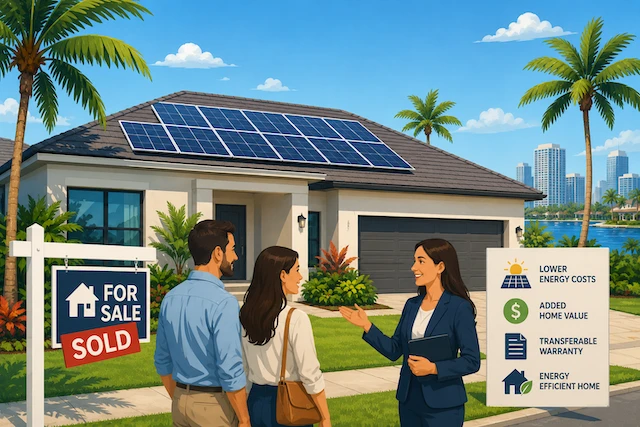
Drive down almost any residential street in South Florida and you’ll see them: dark panels glinting on tile roofs. Florida has become one of the biggest rooftop solar markets in the country, and if you own a system, you already know why. The sun is free. The power bill is not. And for most homeowners, the payback math works.
But now you’re selling. And suddenly everyone has an opinion about your panels. Will they add value or scare buyers off? Do you need to pay something off before closing? Can the next owner even take over your lease?
Here’s the honest answer: in most cases, solar panels are an asset, not a liability. But the details decide whether they help you or slow you down. This guide walks through exactly what matters when you sell a home with solar in Florida, and what to prepare long before the “for sale” sign goes up.
Owned or Leased? This One Detail Changes Everything
The first question buyers, agents, and appraisers will ask isn’t about wattage or panel brand. It’s about who actually owns the system.
That single answer shapes your price, your paperwork, and how smoothly closing goes. So let’s break down each scenario.
Owned Systems: The Cleanest Story
If you bought your panels outright — with cash or a loan you’ve already paid off — selling is straightforward. The system is part of the house, like the air conditioner. You hand over the paperwork, note it in the listing, and the buyer gets a paid-off asset that starts saving them money on day one.
If you’re still making payments on a solar loan, don’t panic. That’s still an owned system in practical terms. The remaining balance is typically paid off at closing from your sale proceeds, and the buyer takes ownership free and clear. Lenders and appraisers treat this like any other paid system, which means financing stays simple.
Leased and PPA Systems: More Moving Parts
A solar lease or power purchase agreement (PPA) is a different story. You don’t own the equipment — a solar company does. The panels stay on the roof, and the buyer has to take over your monthly lease payments to keep them.
That’s where deals get complicated. Lease transfers usually require the buyer to pass a credit check with the solar company. Some buyers love the low upfront cost and the fixed monthly payment. Others see a multi-year obligation they never asked for, and they walk.
The good news is that FHA and Fannie Mae buyers can typically assume a transferable lease as long as the agreement allows it at no cost or a minimal fee. So it’s workable — it just takes more coordination, more paperwork, and a buyer who understands the setup.
Do Solar Panels Actually Raise Your Selling Price?
This is the question every seller asks, and the research is encouraging. Studies from Zillow and Lawrence Berkeley National Laboratory have pegged the typical premium for homes with solar somewhere in the 3-6% range, though results vary by market. In sunny, high-power-cost Florida, that number tends to sit near the favorable end.
But there’s a nuance. Owned systems generally add value, because the buyer inherits free electricity. Leased systems are closer to value-neutral — they don’t hurt much, but they rarely move the price needle either. Appraisers value solar based on comparable sales in your neighborhood, so if nearby homes don’t have panels, your appraiser will dig deeper into production data and energy savings to justify the number. And if you’re not sure where to set the asking price, our guide to pricing your home right for a fast sale covers the fundamentals without the guesswork.
If you’re wondering whether your system counts as one of the upgrades that actually pays off at sale, it often does — and it pairs well with other high-ROI improvements we cover in our guide to the best upgrades for a faster home sale. Just remember that the real value shows up when the paperwork is clean and the numbers are documented.
The Florida Specifics Buyers Will Probe
Florida adds a few wrinkles you won’t find in most other states. Buyers here have learned to ask about them, so get your answers ready.
PACE Loans Are the Wild Card
If you financed your solar with a PACE program — through providers like the Florida PACE Funding Agency or Ygrene — you’re in a different situation entirely. A PACE assessment is tied to the property itself, not to you personally. When you sell, the remaining assessment typically transfers with the house, or the sale price accounts for paying it off.
This matters because PACE assessments can complicate financing. Some lenders hesitate to work with them, and appraisers sometimes discount homes carrying a large assessment. If you have PACE on your roof, disclose it early and have the payoff numbers ready. It won’t kill the deal, but surprises in this category are what push closings back.
Insurance, Roof Age, and Wind Loads
Here’s the thing about solar in Florida: the panels sit on your roof, and your roof sits in the middle of one of the most insurance-challenged markets in America. Carriers are already strict about roof age, and a roof with panels on it needs to be in good shape — because removing and reinstalling panels during a reroof can add thousands to the bill.
The good news is that properly permitted systems in Florida are engineered to handle hurricane wind loads, and Miami-Dade in particular holds solar installs to strict code requirements. That’s a selling point if you can show the permits and inspection records. If you haven’t looked at your policy in a while, this is also a good moment to revisit how coverage is shaking out across the state — it’s one of the factors every seller should understand before listing, and we’ve broken it down in our guide to the Florida home insurance crisis for sellers.
Net Metering and the Utility Account
Florida still offers near-1:1 net metering, which means your utility credits you for the excess power your panels send back to the grid. Tallahassee has flirted with changing those rules for years, so don’t assume they’ll stay exactly the same — but for now, the credits are a real monthly benefit.
When you sell, those net metering credits transfer to the new owner along with the utility account. Pull a recent bill that shows the credits and the production history. It’s one of the simplest, most persuasive documents you can hand a buyer, and it’s the kind of paperwork that makes the whole story click.
The Paperwork Stack You’ll Need to Gather
Solar sales live or die on documentation. Start collecting these items as soon as you decide to list:
- The original contract, whether that’s a purchase, lease, or PPA agreement
- Proof the system is paid off, or the current payoff statement for a loan
- The inverter model, panel warranty, and any transferable workmanship warranties
- Production reports and utility bills showing real savings
- Permits, inspections, and wind load certifications
- Contact info for the solar company, in case the buyer needs a transfer
That stack does double duty: it reassures buyers and it keeps the process moving. For a reminder of everything else you’ll want within reach on sale day, our checklist of the documents you need to sell your house fast is a handy place to start.
Hurricane Season Is a Fair Question
Every Florida buyer who sees panels on a roof will, at some point, ask: “How did these hold up in the last storm?” It’s a fair question, and the answer is usually good news.
Modern rooftop solar is tested for wind loads far beyond what most of South Florida experiences, and many homeowners report panels actually held firm through storms that damaged nearby shingles. Buyers are often more worried than they need to be — especially if they’ve never owned solar. A calm, factual answer backed by your permit paperwork does more than any pitch.
If you’re selling during or right after a rough season, be ready for the question to come up in every showing. It’s one more reason to understand how storms shape the selling climate here — we dug into that in our piece on how hurricanes affect selling your South Florida home, so you can respond with confidence instead of defensiveness.
When the Easier Route Is Selling As-Is
Here’s the part nobody on the real estate forums mentions: solar panels don’t make sense for everyone to sell the traditional way. If your system is leased, the roof is aging, or you just don’t want to spend another weekend chasing paperwork, the as-is route starts looking pretty good.
Selling as-is doesn’t mean hiding the solar situation. It means you’re not obligated to fix, transfer, or perfect anything before the sale. Cash buyers in particular tend to be comfortable with solar in any form — leases, PACE balances, older roofs — because they aren’t depending on a lender’s approval of the deal. If you’re weighing whether to spruce things up or sell straight through, our comparison of selling as-is versus fixing your home lays out the trade-offs in plain terms.
The Bottom Line
Solar panels are a feature, not a flaw — as long as you know what you own and bring the right paperwork. Owned systems add value and sell clean. Leased systems work, but they need a buyer willing to take over the agreement. PACE financing is the one that demands the most upfront transparency, so lead with it.
If your situation feels complicated — an older roof, a lease you can’t transfer, a system tied to an assessment — that’s exactly the kind of case where a direct cash offer cuts through the noise. Cash buyers don’t need financing approval, which means your solar setup rarely becomes a deal-killer in the first place. Curious how those offers get built? We explain how cash home buyers determine their offers in South Florida. And if you’d rather know what your house is worth as-is, with no repairs and no showings, getting a free offer takes about two minutes.
The sun’s been paying you back for years. Now it’s time to make sure it works for you on the way out.