
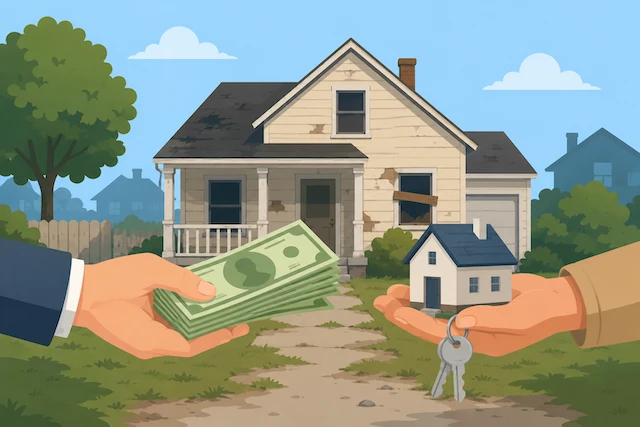
Cash home buyers purchase as-is properties in virtually any condition — damaged, inherited, tenant-occupied, or encumbered by liens. Sellers don’t need to make repairs or wait on bank financing. The as-is model exists because traditional buyers and lenders routinely reject problem properties that still hold real value.
Key Takeaways
- Cash home buyers like Supreme Royalty Investments purchase properties regardless of condition, including fire damage, foundation issues, hoarder situations, and probate estates.
- Sellers avoid repair costs, agent commissions, open houses, and lender-imposed delays that routinely derail traditional sales.
- Research from the National Association of Realtors has consistently shown cash sales representing roughly a quarter of existing home transactions in recent years, reflecting sustained demand from both individual investors and institutional buyers.
- The as-is cash offer process typically moves from initial inquiry to closing in two to four weeks, compared to what is generally 45 days or more for a financed sale — a gap that tends to be wider in active markets like South Florida.
- Property condition issues that commonly prevent a home from qualifying for FHA or conventional financing — such as significant mold, unpermitted work, or structural damage — are generally not barriers to a cash purchase.
- Sellers in difficult situations (divorce, foreclosure, job relocation, landlord burnout) benefit most from the timeline certainty a cash offer provides.
What “As-Is” Actually Means in a Cash Sale
As-is means the buyer accepts the property in its current physical and legal condition, without requiring the seller to remediate defects, complete repairs, or bring the home up to any standard before closing. This is not a vague courtesy phrase — it carries contractual weight and, in Florida, sellers should be aware that selling as-is does not eliminate statutory disclosure obligations. Consulting a real estate attorney about your specific situation is advisable.
In a traditional financed sale, the buyer’s lender orders an appraisal and often requires repairs before the loan is approved. An appraiser who notes a damaged roof, missing handrails, or evidence of mold can trigger mandatory repair conditions. The sale stalls or collapses entirely if the seller cannot or will not comply.
Cash buyers fund the purchase from their own capital. There is no lender, no appraisal contingency, and no repair mandate. The buyer prices the offer to account for the property’s condition, and the seller receives that price without spending a dollar on preparation.
In practice, this distinction matters most when a property has deferred maintenance accumulated over years, when an inherited home has not been touched in months, or when damage from a storm, fire, or water event has left the structure in a state that no conventional buyer would finance.
What As-Is Property Conditions Do Cash Home Buyers Accept?
Structural and System Damage
Foundation cracks, roof failures, failing HVAC systems, and outdated electrical panels are among the most common reasons sellers seek a cash buyer. These repairs are expensive — industry estimates generally place foundation repair costs in the United States anywhere from a few thousand dollars for minor work to well above $20,000 for severe structural issues — and lenders routinely flag them as conditions for loan approval.
Cash buyers evaluate structural issues as part of their offer calculation rather than as deal-breakers. If the foundation needs work, that cost is factored into the offer price. The seller does not bear the cost of fixing it, and the sale is not contingent on repair completion.
For sellers who have been sitting on a property they cannot afford to repair, this model removes the central obstacle. If you want to understand more about this specific scenario, the post on how to sell a house with foundation problems in Florida covers the mechanics in detail.
Fire and Water Damage
Properties with fire or water damage present a particular challenge in the traditional market. Insurance claims complicate title, lenders will not finance uninhabitable structures, and buyers who are interested often submit low offers contingent on extensive inspections and remediation reports.
Cash buyers purchase fire- and water-damaged properties directly, closing on a timeline that works for the seller — often before the owner has to navigate months of contractor bids and insurance negotiations. The post on selling a fire-damaged home in South Florida outlines what sellers in that situation can expect from the process.
Mold and Environmental Issues
Mold is one of the most common reasons a conventional sale falls through after inspection. Buyers get cold feet, lenders require remediation certificates, and the cost of professional mold abatement in Florida can be substantial — industry estimates typically range from several thousand dollars to well above $10,000 depending on the scope and severity.
Cash buyers who specialize in as-is purchases factor mold remediation into their pricing. The property does not need to be cleared before closing. This is covered in more depth in the post on whether cash buyers purchase homes with mold problems.
Hoarding and Extreme Clutter
Sellers of hoarded properties face a logistical and emotional challenge that goes beyond typical cleanup. The cost of professional junk removal and cleaning for a hoarding situation can be significant — in severe cases, industry pricing commonly runs into the tens of thousands of dollars — and many sellers simply do not have the energy or resources to undertake it.
Cash buyers purchase hoarded homes without requiring any cleanup before closing. The seller takes what they want and leaves the rest. Supreme Royalty Investments handles properties in exactly this condition across South Florida — see how to sell a hoarder house without cleaning it first for a practical breakdown.
Homes with Code Violations and Unpermitted Work
Unpermitted additions, code violations, and open permits create title complications that stop financed sales before they start. A buyer using a mortgage cannot close on a property with open code violations in most Florida jurisdictions without resolution.
Cash buyers can close on properties with these issues because they are not bound by lender requirements. They typically either resolve the violations post-closing or price the cost into the offer. The posts on selling a home with unpermitted work in Florida and selling a house with code violations in Miami address the specific legal and procedural considerations.
What Seller Situations Benefit Most from a Cash Sale?
Inherited Properties and Probate Estates
Inherited properties often come with complications: out-of-state heirs, probate proceedings, outdated interiors, and deferred maintenance. The emotional weight of managing a deceased family member’s home while navigating legal processes makes the simplicity of a direct cash sale particularly valuable.
A cash buyer can work alongside the probate process and close once the estate is cleared, without requiring the heirs to invest in repairs or hold the property for months while it sits on the market. The post on selling probate property in South Florida covers the legal framework sellers need to understand.
Foreclosure and Late Mortgage Payments
Sellers facing foreclosure have a shrinking window to act. A traditional listing that takes 60 or 90 days to close may not clear before a scheduled auction date. A cash sale that closes in two weeks can stop the process and protect the seller’s credit and equity.
According to ATTOM Data Solutions, Florida consistently ranks among the top five states for foreclosure filings, making this scenario more common in South Florida than in most of the country. If this is your situation, the posts on stopping foreclosure in South Florida before auction and selling behind on payments lay out the timeline options clearly.
Landlords Ready to Exit
Landlord burnout is real. Tenant disputes, non-payment, property damage, and rising insurance and maintenance costs have accelerated the decision for many South Florida rental owners to exit in 2025 and 2026. Selling a tenant-occupied property through a traditional listing is complicated — tenants must be given notice, showings are disruptive, and buyers who need the property vacant may walk.
Cash buyers purchase tenant-occupied properties as-is, often taking over existing leases or handling the tenant transition themselves. This removes the seller from one of the most friction-heavy parts of the exit process. The post on selling rentals with tenants in South Florida explains both the legal requirements and the strategic options.
Divorce
Selling a shared property during divorce adds legal and emotional complexity to an already difficult process. When both parties agree that a fast, clean sale is the priority, a cash offer with a defined closing date removes months of uncertainty. There are no staging negotiations, no endless showings, and no risk of a buyer’s financing falling through after four weeks under contract.
Job Relocation
A seller who needs to be in a new city in 30 days cannot afford the standard listing timeline. The post on how to sell your house fast in Miami outlines the timeline comparison in the Miami market specifically.
How Does the Cash Offer Process Work?
- Submit the property address. Supreme Royalty Investments reviews the property location, condition, and local comparable sales. No in-person meeting is required at this stage.
- Receive a no-obligation offer. The offer is built on the home’s as-is condition — not a theoretical post-renovation value. There is no obligation to accept.
- Review and accept on your timeline. If the offer works, the seller selects a closing date. Fast closings can happen in as little as two weeks; sellers who need more time to arrange a move can request a later date.
- Close and receive payment. There are no lender delays, no last-minute financing conditions, and no appraisal gaps to negotiate. The seller walks away with cash at closing.
The entire process eliminates the variables that cause traditional sales to collapse: buyer financing contingencies, inspection repair requests, appraisal shortfalls, and lender-imposed conditions.
What Is the Difference Between an As-Is Cash Offer and a Traditional Sale?
| Factor | Cash As-Is Sale | Traditional Financed Sale |
|---|---|---|
| Repairs required | None | Often required by lender or buyer |
| Time to close | 2–4 weeks | 43–60 days (South Florida average) |
| Appraisal required | No | Yes |
| Open houses / showings | None | Multiple, ongoing |
| Financing contingency | None | Standard — failure rate ~5–10% |
| Agent commission | None | Typically 5–6% of sale price |
| Condition flexibility | Any condition | Move-in ready preferred |
| Closing date control | Seller chooses | Subject to buyer and lender |
The trade-off sellers accept in a cash sale is that the offer will be below the theoretical maximum sale price achievable in an ideal traditional market. The practical question is not what price a perfect sale might achieve — it is what net proceeds a seller actually receives after repairs, commissions, carrying costs, and the months of uncertainty a traditional listing involves.
Frequently Asked Questions
Does a property need to pass inspection to sell for cash?
No. Cash buyers do not require a seller-ordered inspection before making an offer, and there is no lender-mandated inspection condition to satisfy. A cash buyer may conduct their own walkthrough to assess condition, but the offer reflects the as-is state of the property — the buyer does not come back after inspection with a list of repair demands.
How do cash buyers determine the offer price on a damaged property?
Cash buyers assess the property’s current condition, estimate the cost of necessary repairs or upgrades, and compare the property against recent local sales of similar homes in repaired condition. The offer accounts for the buyer’s cost to bring the property to resale or rental standard. This is why as-is offers are below full retail value — but they are also certain, fast, and cost the seller nothing in preparation.
Can you sell a house with liens or back taxes for cash?
Yes, in most cases. Liens and delinquent property taxes complicate but do not prevent a cash sale. In many transactions, outstanding liens are resolved at closing from the sale proceeds, with the buyer facilitating the payoff through the title company. The post on selling a house with delinquent property taxes in Florida covers this in detail.
Is there a cost to request a cash offer from Supreme Royalty Investments?
No. Requesting an offer from Supreme Royalty Investments is free and carries no obligation. Sellers can evaluate the offer and decide whether it makes sense for their situation without any pressure or commitment.
What types of properties does Supreme Royalty Investments purchase?
Supreme Royalty Investments considers single-family homes, townhomes, condos, and small multi-family properties throughout South Florida in any condition. Properties with damage, code violations, tenants, probate complications, or significant deferred maintenance all qualify for a cash offer.
How quickly can a cash sale actually close in Florida?
In straightforward cases, closing can occur in as few as 10 to 14 days from acceptance. More complex situations — such as probate properties or homes with title issues — may require additional time to clear title, but the cash purchase itself does not depend on mortgage timelines. Sellers who need more time can also request a closing date several weeks or months out.
The Right Time to Request a Cash Offer
If the cost, timeline, or complexity of a traditional sale is the thing standing between you and moving on, a cash offer is the most direct way to find out what your options actually are. Supreme Royalty Investments makes no-obligation offers on properties across South Florida in any condition — outdated, damaged, occupied, or legally complicated.
Submit your address at supremeroyaltyinvestments.co to get a fair, as-is cash offer with no repair requirements, no agent fees, and no pressure to accept.